"Ceci n'est pas un article des Echos": anatomy of a media impersonation campaign
This past July, Les Echos journalist Charlie Perreau sounded the alarm on LinkedIn: sponsored posts dressed up as the French business daily were making the rounds on social media. A striking case, and far from an isolated one. So we pulled the numbers. Here's what a full year of AdsWizard data reveals about the scale of the practice, how it works, and who is behind it.
What is media impersonation?
The idea is simple: an advertiser mocks up a fake front page or article that copies everything from a news brand, layout, typography, logo, section headers, then sponsors it like any other ad. The point is to capture credibility the outlet never agreed to lend, and use that journalistic sheen to sell a commercial offer, a shady investment or an outright scam.
Readers think they're opening an article from Les Echos, Le Monde or Libération. Instead, they land on a fake casino site, a bogus flash sale or a phishing form.
And this reaches far beyond any single outlet. According to "The Scam Ad Machine", a study released by Gen Threat Labs in February 2026, more than one in four ads running on Meta in France is a scam of one kind or another. Not isolated incidents: an industry, one that targets news brands and consumer brands alike.
A year of fake Les Echos ads
Integrity, AdsWizard's detection engine, scanned Meta ads between July 29, 2025 and July 31, 2026. This is what it picked up for the Les Echos brand:
The advertiser breakdown tells its own story. Two accounts dominate: RealGen (573 ads) and Bulldozer Collective (209). Between them, they account for 89% of everything we detected. More telling still: our data shows they share the same media buyer. Two storefronts, one operator. The rest is spread across sixteen smaller advertisers.
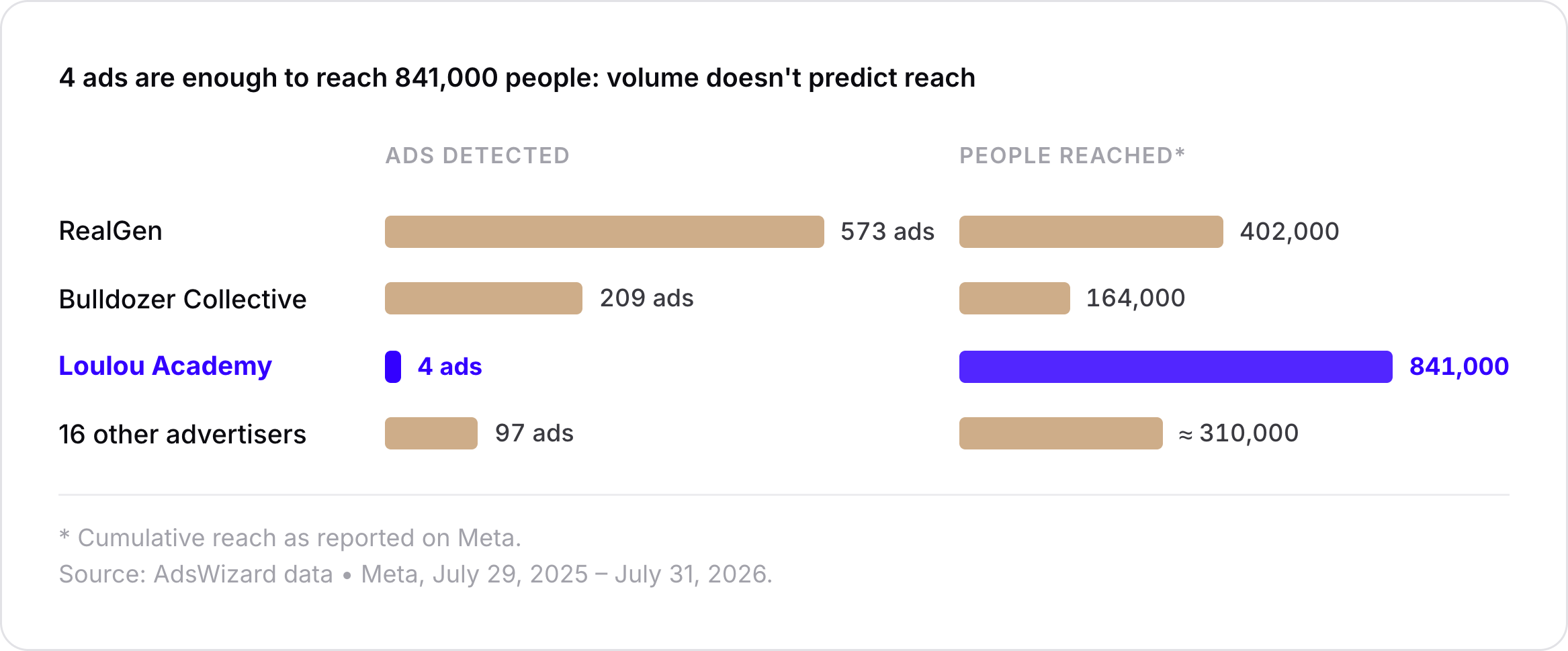
The audience data holds a surprise of its own: volume doesn't predict reach. Loulou Academy reached 841,000 people with just 4 ads; Bulldozer Collective reached 164,000 with 209. A handful of well-targeted campaigns is all it takes to put a fake front page in front of a very large audience.
Why nobody is seeing it
This is the heart of the problem. Meta moderates late, and never notifies the brand or outlet being impersonated. Some of the ads we detected even carry Meta's own label: "This ad was run by an account or Page we later disabled." Disabled, yes, but after it ran. By the time a fake ad comes down, it has already found its audience, and the outlet never knew it existed.
Some of the reactions under Charlie Perreau's post make the point better than any statistic. These aren't distracted scrollers; they're marketing, product and tech professionals:
“I saw it in my feed, I was convinced it was a real article!”
A VP Brand & Communications
“I've been seeing it for a week now, convinced it was the real thing.”
A product & strategy executive
“At first glance, you can't tell it's an imitation.”
An R&D project manager
For a news brand, this is about much more than embarrassment. Trust in a media outlet takes decades to build; here, it gets rented out in a click. Lost credibility, defrauded readers, brand dilution, traffic siphoned off by fraudsters: the costs are real, and they stay invisible for as long as no one is measuring.
And what goes for media goes for brands. The same playbook moves counterfeits and fake private sales by impersonating luxury houses and premium names.
Against a practice this industrialized, and this invisible from the inside, there is only one answer: measure it. That's exactly what Integrity is for: making every brand and media impersonation visible, continuously, evidence included.
Sources: AdsWizard data • Gen Threat Labs, "The Scam Ad Machine", February 2026.